Series Convergence Explorer

Watch partial sums grow. Does the series converge to a finite limit or diverge?

Loading interactive simulation...

Fifty terms, six correct decimals

Pick 1/n² at N = 50 and the page prints S50 = 1.625133, still 0.0198 short of π²/6. That shortfall is the tail you left out, and the tail is nearly an area: the terms after the 50th add up to almost exactly the area under 1/x² beyond 50, which is 1/50, less half the 50th term. Put it back and 1.625133 + 0.02 − 0.0002 = 1.644933, wrong only in the sixth decimal (the error is 1.3 × 10⁻⁶). The plain sum needs about 750,000 terms to get as close. At N = 10 the same correction gives 1.549768 + 0.1 − 0.005 = 1.644768, three decimals from ten terms.

What a partial sum really is

An infinite series is never summed all at once. Instead you track the partial sum SN, the running total of the first N terms, and watch where it heads as N grows. On the chart, if that curve flattens toward a horizontal line, the series converges to that height; if it keeps climbing, it diverges. Convergence is really just a sequence of totals settling down.

How the harmonic series stacks blocks

Stack identical blocks at the edge of a table. The top one can overhang the edge by at most ½ HN, half the N-th harmonic partial sum. Because the harmonic series diverges, this overhang has no limit — with enough blocks the top one hangs entirely past the table edge and beyond. Just 4 blocks already clear a full block-length, since H4 ≈ 2.08.

SERIES THEORY — WHICH CONVERGENCE TEST TO REACH FOR

Choosing a Convergence Test: Match the Test to the Shape

No single test settles every series. Each one is tuned to a particular shape of general term — a constant ratio, a plain power of n, a factorial, alternating signs — and applying the wrong one usually returns "inconclusive" rather than a wrong answer. Read the term first, recognise its shape, and the test picks itself.

nth-term test — the one that can only prove divergence lim an ≠ 0 ⇒ ∑an → ∞
Geometric — a constant ratio between terms Σarn, |r| < 1
p-series — a plain power of n underneath Σ1/np, p > 1
Ratio test — factorials and n-th powers L = lim |an+1/an|
Alternating — the sign flips every term Σ(−1)nbn, bn ↓ 0
Telescoping — the middle of the sum cancels Σ[f(n) − f(n+1)]

01

nth-term test — the one that can only prove divergence

Term looks like: Any series at all. Check this first; it costs a single limit.

Test: lim an ≠ 0 ⇒ ∑an → ∞

Worked example: Σ1/n has aₙ → 0, so the test says nothing — and the series diverges anyway.

Open this case: Harmonic
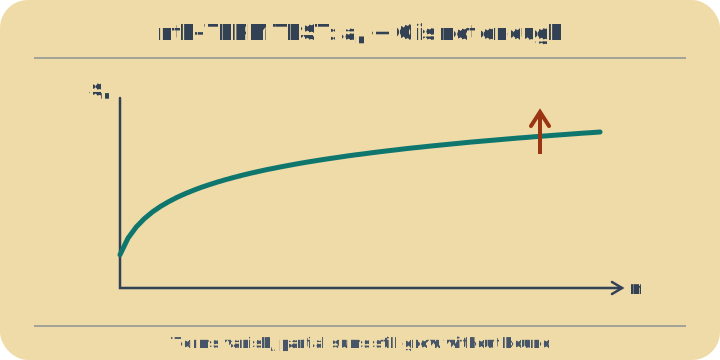
nth-term test — the one that can only prove divergence. Harmonic partial sums keep climbing even though the individual terms vanish. Any series at all. Check this first; it costs a single limit.
Harmonic partial sums keep climbing even though the individual terms vanish.

02

Geometric — a constant ratio between terms

Term looks like: Each term is a fixed multiple of the one before: aₙ₊₁/aₙ = r, the same r throughout.

Test: Σarn, |r| < 1

Worked example: Σ(1/2)ⁿ has r = 1/2, so it converges — and the total is exactly a/(1 − r).

Open this case: Geometric
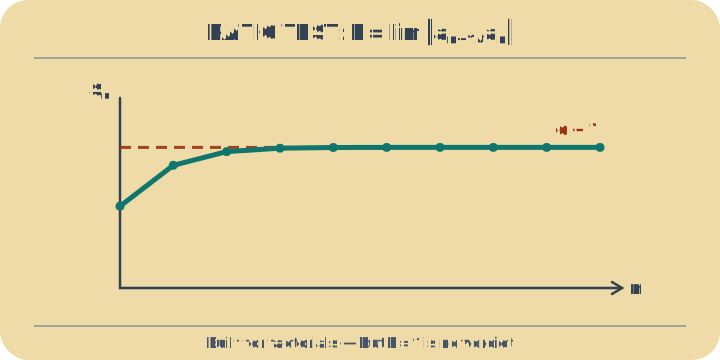
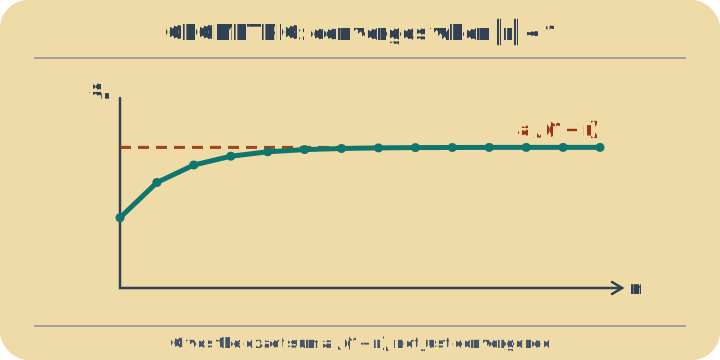
Geometric — a constant ratio between terms. A constant ratio below 1: the partial sums flatten onto the exact limit. Each term is a fixed multiple of the one before: aₙ₊₁/aₙ = r, the same r throughout.
A constant ratio below 1: the partial sums flatten onto the exact limit.

03

p-series — a plain power of n underneath

Term looks like: The term is 1/nᵖ and nothing more: no factorial, no alternating sign.

Test: Σ1/np, p > 1

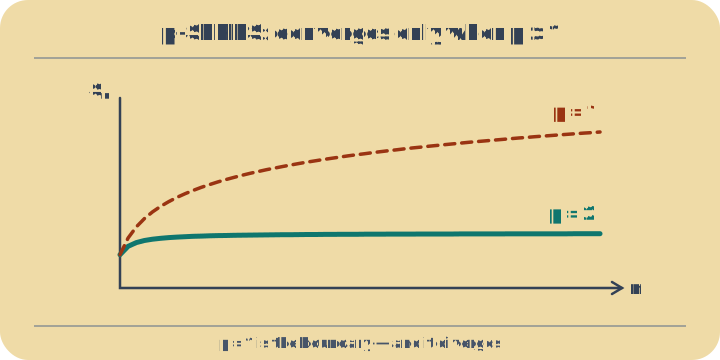
Worked example: 1/n² converges (p = 2); 1/n diverges (p = 1). The boundary is exactly p = 1.

Open this case: p-series
p-series — a plain power of n underneath. p = 2 settles quickly while p = 1 keeps climbing. The threshold is exactly p = 1. The term is 1/nᵖ and nothing more: no factorial, no alternating sign.
p = 2 settles quickly while p = 1 keeps climbing. The threshold is exactly p = 1.

04

Ratio test — factorials and n-th powers

Term looks like: The term contains n!, cⁿ or nⁿ. Compute L = lim |aₙ₊₁/aₙ|.

Test: L = lim |an+1/an|

Worked example: Σ1/n! gives L = lim 1/(n+1) = 0 < 1, so it converges — and very fast.

Open this case: e−1 series
Ratio test — factorials and n-th powers. 1/n! collapses onto its limit within a handful of terms. The term contains n!, cⁿ or nⁿ. Compute L = lim |aₙ₊₁/aₙ|.
1/n! collapses onto its limit within a handful of terms.

05

Alternating — the sign flips every term

Term looks like: The term carries (−1)ⁿ, and the magnitudes decrease steadily to zero.

Test: Σ(−1)nbn, bn ↓ 0

Worked example: Σ(−1)ⁿ⁺¹/n converges to ln 2, even though Σ1/n diverges.

Open this case: Alt. Harmonic
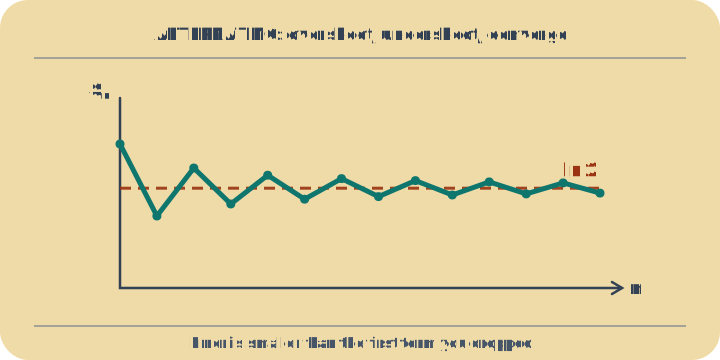
Alternating — the sign flips every term. Partial sums overshoot and undershoot in turn, closing in on the limit. The term carries (−1)ⁿ, and the magnitudes decrease steadily to zero.
Partial sums overshoot and undershoot in turn, closing in on the limit.

06

Telescoping — the middle of the sum cancels

Term looks like: The term splits into a difference f(n) − f(n+1), usually via partial fractions.

Test: Σ[f(n) − f(n+1)]

Worked example: 1/(n(n+1)) = 1/n − 1/(n+1), so Sₙ = 1 − 1/(n+1) → 1.

Open this case: Telescoping
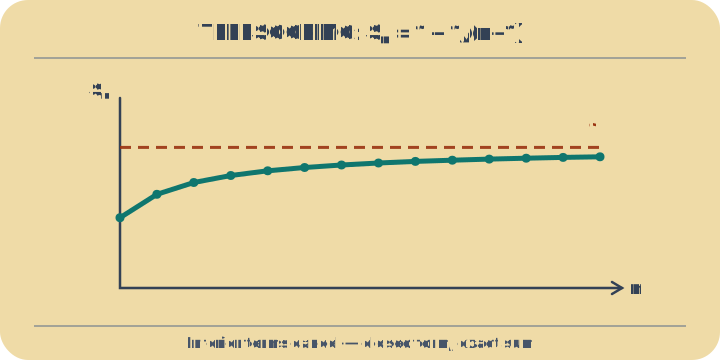
Telescoping — the middle of the sum cancels. Everything between the first and last term cancels, leaving Sₙ = 1 − 1/(n+1). The term splits into a difference f(n) − f(n+1), usually via partial fractions.
Everything between the first and last term cancels, leaving Sₙ = 1 − 1/(n+1).
References (2)

Problem solved in full

  1. The 50th partial sum of 1 + 1/2 + 1/3 + … 5 steps

    The 50th partial sum of 1 + 1/2 + 1/3 + … is 4.499, the terms are down to 0.02, and the ratio test comes back 0.98. Everything on the panel looks like convergence. Prove it diverges — and then work out how far you would have to go to reach 100.

    1. Clear the ratio test out of the way first. It compares consecutive terms, and for 1/n that ratio is (n − 1)/n, which climbs to 1 from below no matter what. The test returns inconclusive, not converges. A page that printed 0.98 without that word would be misleading by omission.

      ∣a50a49∣=4950=0.98 ⟶ 1(test inconclusive)\left|\frac{a_{50}}{a_{49}}\right|=\frac{49}{50}=0.98\ \longrightarrow\ 1\quad(\text{test inconclusive})
    2. The proof is Oresme's and it is seven centuries old. Group the terms into blocks ending at each power of two: 1/3 + 1/4 exceeds 1/2, the next four terms exceed 1/2, the next eight do too. Every block contributes at least a half, and there are infinitely many blocks.

      ∑n=12m1n ≥ 1+m2⟹unbounded\sum_{n=1}^{2^m}\frac1n\ \ge\ 1+\frac{m}{2}\quad\Longrightarrow\quad \text{unbounded}
    3. That settles divergence but gives no rate, and the rate is what makes divergence believable against a printed sum of 4.5. Comparing the sum with ∫dx/x supplies one: the partial sums track ln n plus a constant, and that constant is γ.

      Hn=ln⁡n+γ+12n+O(n−2),γ=0.5772157H_n=\ln n+\gamma+\frac{1}{2n}+O(n^{-2}),\qquad \gamma=0.5772157
    4. Test it. ln 50 + γ = 4.489239 against the printed 4.499205, and the 0.009967 left over is the next term of the expansion, 1/2n = 0.01. The approximation is not merely close; it is close in a way that predicts its own error.

      ln⁡50+γ=4.489239,4.499205−4.489239=0.009967≈12×50\ln 50+\gamma=4.489239,\qquad 4.499205-4.489239=0.009967\approx\frac{1}{2\times50}
    5. So invert it. A sum of 10 needs about e^(10−γ) ≈ 12 000 terms. A sum of 100 needs e^(100−γ).

      Hn=100 ⟹ n≈e 100−γ=1.5×1043H_n=100\ \Longrightarrow\ n\approx e^{\,100-\gamma}=1.5\times10^{43}

    Answer

    The tool prints 4.499205 after 50 terms and calls the series divergent, and both are true at once — which is the entire difficulty of this example. The sum grows like ln n, so it does pass every finite target eventually. Reaching 10 takes around 12 000 terms; reaching 100 takes 1.5 × 10⁴³. Divergence is a claim about eternity, not about the next few thousand terms, and 1/n is the standard proof that those are not the same thing. Switch the series to 1/n² and the same 50 terms settle at 1.625 and stay there: π²/6 is 1.645, and the entire infinite remainder is worth 0.02.

    H50=4.499205,Hn∼ln⁡n ⟹ Hn=100 at n≈1.5×1043H_{50}=4.499205,\qquad H_n\sim\ln n\ \Longrightarrow\ H_n=100\ \text{at}\ n\approx1.5\times10^{43}

Learning path

Infinite series and convergence