Momentum & Collision Lab

Simulate 1D cart collisions to explore conservation of momentum, kinetic energy changes, and the coefficient of restitution.

Momentum is conserved in every collision m1u1+m2u2=m1v1+m2v2m_1u_1+m_2u_2=m_1v_1+m_2v_2
Restitution: e = 1 elastic, e = 0 they stick v2−v1=e (u1−u2),0≤e≤1v_2-v_1=e\,(u_1-u_2),\qquad 0\le e\le1
Impulse: the change in momentum J=Fˉ Δt=m(v−u)=ΔpJ=\bar F\,\Delta t=m(v-u)=\Delta p
Loading interactive simulation...

Lesson

The theory — Momentum & Collision Lab

The momentum of a body is its mass times its velocity, p = mv, and in one dimension its sign is its direction. In a collision the two carts push on each other and on nothing else, so their total momentum is the same after as before, whatever the collision does to their kinetic energy.

What each symbol means

p
momentum, mv, in kg·m/s. Right is positive, so a cart moving left carries negative momentum.
u
a velocity before the collision: u₁ for cart 1 on the left, u₂ for cart 2 on the right. The carts meet only if u₁ > u₂.
v
a velocity after the collision.
e
the coefficient of restitution, the speed at which the carts separate divided by the speed at which they met. 1 gives back all the kinetic energy of their relative motion; 0 makes them stick.
J
the impulse, the change in one cart's momentum, in N·s. Over a contact lasting Δt it is the average force times Δt.

Where the formula comes from

  1. Impulse is the change in momentum. Newton's second law summed over the contact: the force times the time it acts is the momentum it adds.
    J=∫F dt=Fˉ Δt=m(v−u)=ΔpJ=\int F\,dt=\bar F\,\Delta t=m(v-u)=\Delta p
  2. Newton's third law makes the two impulses equal and opposite. Each cart pushes the other as hard as it is pushed, for the same contact time, so whatever cart 2 gains, cart 1 loses.
    m2(v2−u2)=−m1(v1−u1)⇒ m1u1+m2u2=m1v1+m2v2\begin{gathered}m_2(v_2-u_2)=-m_1(v_1-u_1)\\ \Rightarrow\ m_1u_1+m_2u_2=m_1v_1+m_2v_2\end{gathered}
  3. That is one equation for two unknowns, and restitution is the second. It compares how fast the carts separate with how fast they met, and it is the only place the kind of collision enters.
    v2−v1=e (u1−u2)v_2-v_1=e\,(u_1-u_2)
  4. Solve the pair. These are the formulas the results table works through.
    v1=(m1−em2)u1+m2(1+e)u2m1+m2v2=(m2−em1)u2+m1(1+e)u1m1+m2\begin{gathered}v_1=\frac{(m_1-em_2)u_1+m_2(1+e)u_2}{m_1+m_2}\\ v_2=\frac{(m_2-em_1)u_2+m_1(1+e)u_1}{m_1+m_2}\end{gathered}
  5. The kinetic energy lost depends only on the relative speed. It is zero at e = 1 and largest at e = 0, when the carts stick; the same masses meeting at the same relative speed lose the same energy wherever the pair as a whole is going.
    ΔK=12 m1m2m1+m2 (1−e2) (u1−u2)2\Delta K=\tfrac12\,\frac{m_1m_2}{m_1+m_2}\,(1-e^{2})\,(u_1-u_2)^{2}
Assumes
The carts move along one line and touch only each other during the contact, so friction and the track add no impulse while it lasts. The restitution is one number for the pair, though for real materials it falls as the impact gets harder. The animation's walls are outside the two-cart system: a wall bounce reverses one cart, which changes the total momentum and leaves the kinetic energy alone.
Both carts take the same impulse

Whatever the masses, the two carts receive impulses of the same size in opposite directions. Each pushes the other exactly as hard as it is pushed, which is Newton's third law, and for the same contact time, so conservation of momentum is those two impulses cancelling and nothing more. Press Light hits heavy: the impulse on the 8 kg cart is 5.3333 N·s, and the 1 kg cart's momentum changes by the same amount the other way, from 3 to −2.3333 kg·m/s. The light cart's velocity changes eight times as much because it has an eighth of the mass. A fly hitting a windscreen pushes on the glass as hard as the glass pushes on the fly; the outcomes differ only in the mass each force has to move.

The one number that sets the bounce

The coefficient of restitution e is this tool's master dial. It is the separation speed divided by the approach speed: e = 1 is a perfect rebound that no real ball reaches (a superball manages about 0.9), while e = 0 means the carts stick together like wet clay. You can measure it at home — drop a ball and divide bounce height by drop height, which equals e². A basketball that returns to about 64% of its drop height has e ≈ 0.8.

Voyager 2 played billiards with Jupiter

A spacecraft gravity assist obeys these exact rules with nothing ever touching. In the planet's reference frame the flyby is perfectly elastic (e = 1): the probe leaves at the same speed it arrived, merely redirected. But in the Sun's frame it can pick up almost twice the planet's orbital speed. Voyager 2 gained roughly 10 km/s at Jupiter this way — borrowed from the planet's orbital motion, which slowed by an utterly negligible amount in return.

COLLISIONS — MOMENTUM ALWAYS SURVIVES, ENERGY OFTEN DOES NOT

Which Collision Are You Modelling?

Every collision here conserves momentum: m₁u₁ + m₂u₂ is the same before and after, always. What separates the cases is how much kinetic energy survives, and one number decides that — the coefficient of restitution e, the separation speed divided by the approach speed. Fix e first; then the mass ratio tells you who ends up going where.

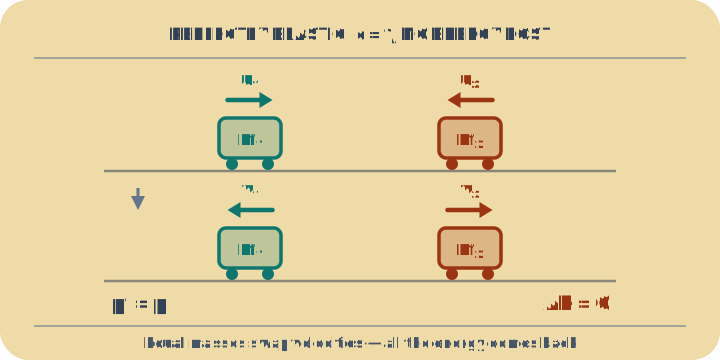
Perfectly elastic (e = 1) — kinetic energy survives intact e = 1, K′ = K
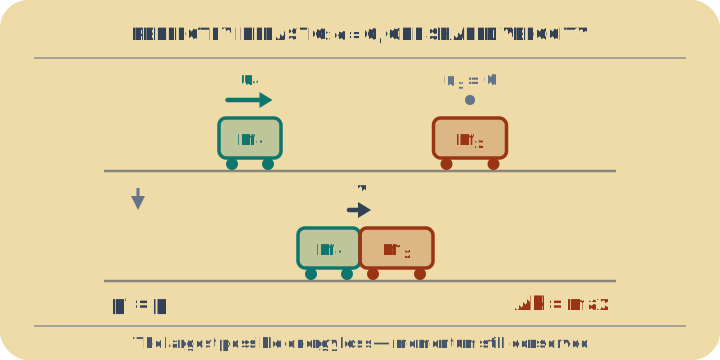
Perfectly inelastic (e = 0) — they stick, and lose the most e = 0, v₁ = v₂
Partially elastic (0 < e < 1) — the real-world middle e = (v₂ − v₁)/(u₁ − u₂)
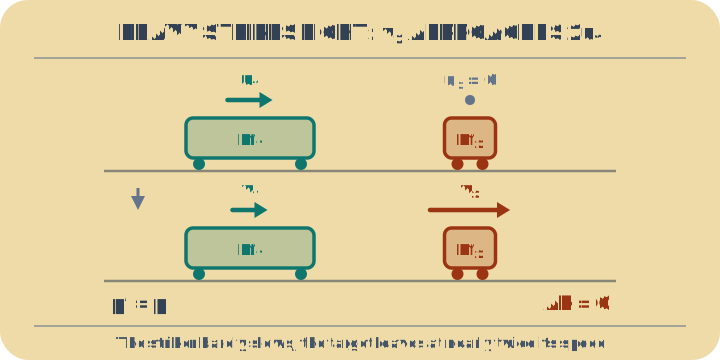
Heavy strikes light — the small one is launched m₁ ≫ m₂ ⇒ v₂ → 2u₁
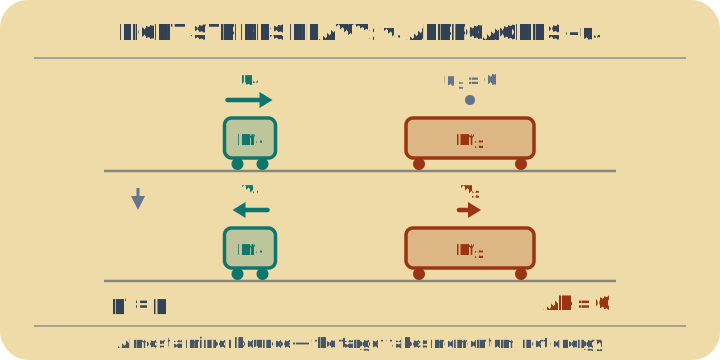
Light strikes heavy — it bounces straight back m₁ ≪ m₂ ⇒ v₁ → −u₁

01

Perfectly elastic (e = 1) — kinetic energy survives intact

What you know: Nothing deforms permanently and nothing heats up: the carts separate exactly as fast as they approached. Momentum and kinetic energy are both conserved.

Restitution: e = 1, K′ = K

Worked example: 2 kg at +3 m/s meets 2 kg at −3 m/s with e = 1 → they leave at −3 and +3 m/s. The velocities swap, and all 18 J is still there.

Open this case: Billiard balls bounce
Perfectly elastic (e = 1) — kinetic energy survives intact. Equal masses at e = 1: the carts trade velocities and keep every joule. Nothing deforms permanently and nothing heats up: the carts separate exactly as fast as they approached. Momentum and kinetic energy are both conserved.
Equal masses at e = 1: the carts trade velocities and keep every joule.

02

Perfectly inelastic (e = 0) — they stick, and lose the most

What you know: The carts leave with one shared velocity, so the separation speed is zero. Momentum still balances, but the kinetic-energy loss is as large as it can possibly be.

Restitution: e = 0, v₁ = v₂

Worked example: 2 kg at 3 m/s hits a stationary 3 kg with e = 0 → both move off at 1.2 m/s, and 5.4 J of the original 9 J is gone: 60% lost.

Open this case: Inelastic stick
Perfectly inelastic (e = 0) — they stick, and lose the most. At e = 0 the carts move off together, and the missing energy has gone into damage. The carts leave with one shared velocity, so the separation speed is zero. Momentum still balances, but the kinetic-energy loss is as large as it can possibly be.
At e = 0 the carts move off together, and the missing energy has gone into damage.

03

Partially elastic (0 < e < 1) — the real-world middle

What you know: The carts do separate, but more slowly than they approached. e is the ratio between the two: e = (v₂ − v₁)/(u₁ − u₂).

Restitution: e = (v₂ − v₁)/(u₁ − u₂)

Worked example: 3 kg at +4 m/s meets 2 kg at −2 m/s with e = 0.5 → v₁ = +0.4 and v₂ = +3.4 m/s. The 6 m/s approach comes back as 3 m/s, and 16.2 J of the 28 J is lost.

Open this case: Real bumper bounce
Partially elastic (0 < e < 1) — the real-world middle. With 0 < e < 1 they part more slowly than they met, and the difference leaves as heat. The carts do separate, but more slowly than they approached. e is the ratio between the two: e = (v₂ − v₁)/(u₁ − u₂).
With 0 < e < 1 they part more slowly than they met, and the difference leaves as heat.

04

Heavy strikes light — the small one is launched

What you know: An elastic collision with m₁ much larger than m₂. The heavy cart barely notices the impact; the light one leaves faster than anything arrived.

Restitution: m₁ ≫ m₂ ⇒ v₂ → 2u₁

Worked example: 8 kg at 3 m/s hits a stationary 1 kg elastically → the heavy cart only slows to 2.33 m/s while the light one leaves at 5.33 m/s, near the 2u₁ ceiling.

Open this case: Heavy hits light
Heavy strikes light — the small one is launched. With m₁ ≫ m₂ the heavy cart rolls on almost unchanged and the light one is flung forward. An elastic collision with m₁ much larger than m₂. The heavy cart barely notices the impact; the light one leaves faster than anything arrived.
With m₁ ≫ m₂ the heavy cart rolls on almost unchanged and the light one is flung forward.

05

Light strikes heavy — it bounces straight back

What you know: An elastic collision with m₁ much smaller than m₂. The incoming cart reverses direction; the heavy one hardly moves.

Restitution: m₁ ≪ m₂ ⇒ v₁ → −u₁

Worked example: 1 kg at 3 m/s hits a stationary 8 kg elastically → the light cart rebounds at −2.33 m/s and the heavy one creeps forward at 0.67 m/s.

Open this case: Light hits heavy
Light strikes heavy — it bounces straight back. With m₁ ≪ m₂ the light cart rebounds at nearly its arrival speed and the heavy one hardly stirs. An elastic collision with m₁ much smaller than m₂. The incoming cart reverses direction; the heavy one hardly moves.
With m₁ ≪ m₂ the light cart rebounds at nearly its arrival speed and the heavy one hardly stirs.
References (1)

Problems solved in full

  1. A 2 kg cart meeting a 3 kg cart elastically 5 steps

    A 2 kg cart at 3 m/s meets a 3 kg cart at −1 m/s, elastically. Find both final velocities from the two conservation laws, and then what the same collision costs if the carts stick together instead.

    1. Momentum first, because it holds whatever the collision does. Signs carry the directions, so the second cart's −1 subtracts.

      p:m1u1+m2u2=2(3)+3(−1)=3 kg m/sp:\quad m_1u_1+m_2u_2=2(3)+3(-1)=3\ \mathrm{kg\,m/s}
    2. Kinetic energy is the second constraint, and it is the one that only holds when the collision is elastic. 10.5 J goes in.

      K:12(2)(3)2+12(3)(−1)2=9+1.5=10.5 JK:\quad \tfrac12(2)(3)^2+\tfrac12(3)(-1)^2=9+1.5=10.5\ \mathrm{J}
    3. Solving two equations, one of them quadratic, is avoidable. In an elastic collision the relative velocity reverses: the carts separate as fast as they approached, and that linear statement replaces the energy equation exactly.

      e=1:v2−v1=e(u1−u2)=4,m1v1+m2v2=3e=1:\quad v_2-v_1=e(u_1-u_2)=4,\qquad m_1v_1+m_2v_2=3
    4. Two linear equations then give both velocities directly. The light cart bounces backwards; the heavy one is pushed forwards but ends up slower than the light one arrived.

      ⟹ v1=−1.8 m/s,v2=2.2 m/s\Longrightarrow\ v_1=-1.8\ \mathrm{m/s},\qquad v_2=2.2\ \mathrm{m/s}
    5. Now set the restitution to zero and the carts move off together at the mass-weighted average of their velocities, 0.6 m/s, carrying 0.9 J.

      e=0: v=35=0.6 m/s, Kf=12(5)(0.6)2=0.9 J, Ki−KfKi=9.610.5=91.43%e=0:\ v=\frac{3}{5}=0.6\ \mathrm{m/s},\ K_f=\tfrac12(5)(0.6)^2=0.9\ \mathrm{J},\ \frac{K_i-K_f}{K_i}=\frac{9.6}{10.5}=91.43\%

    Answer

    The tool prints 3 kg·m/s before and after, and 10.5 J before and after: momentum and energy both conserved, which is what elastic means. Set the restitution to 0 and the momentum still reads 3, while the kinetic energy after drops to 0.9 J. 91.43% of the kinetic energy is gone, into heat, sound and permanent deformation, and the momentum does not notice.

    e=1: v1=−1.8, v2=2.2 m/s, Kf=Ki;e=0: v=0.6 m/s, ΔKKi=91.43%e=1:\ v_1=-1.8,\ v_2=2.2\ \mathrm{m/s},\ K_f=K_i;\qquad e=0:\ v=0.6\ \mathrm{m/s},\ \frac{\Delta K}{K_i}=91.43\%
  2. Two carts that stick 4 steps

    A 4.0 kg cart moving right at 2.5 m/s meets a 1.0 kg cart moving left at 5.0 m/s, and they couple together. Find their common velocity and the kinetic energy lost.

    Open this problem in the tool

    Show solution
    1. Momentum before, with right positive, so the 1.0 kg cart's velocity is −5.0 m/s:

      Pi=4(2.5)+1(−5)=5 kg m/sP_i=4(2{.}5)+1(-5)=5\ \mathrm{kg\,m/s}
    2. They leave with one velocity, which carries all of that momentum:

      (m1+m2)v=Pi ⇒ v=55=1 m/s(m_1+m_2)v=P_i\ \Rightarrow\ v=\frac{5}{5}=1\ \mathrm{m/s}
    3. Kinetic energy before and after:

      Ki=12(4)(2.5)2+12(1)(5)2=12.5+12.5=25 J,Kf=12(5)(1)2=2.5 JK_i=\tfrac12(4)(2{.}5)^{2}+\tfrac12(1)(5)^{2}=12{.}5+12{.}5=25\ \mathrm{J},\qquad K_f=\tfrac12(5)(1)^{2}=2{.}5\ \mathrm{J}
    4. The difference is the loss, and the relative-speed formula gives it without the final velocity:

      ΔK=25−2.5=22.5 J=12⋅4⋅14+1⋅(2.5+5)2\Delta K=25-2{.}5=22{.}5\ \mathrm{J}=\tfrac12\cdot\frac{4\cdot1}{4+1}\cdot(2{.}5+5)^{2}

    Answer

    1 m/s to the right, and 22.5 J of the 25 J is lost: 90%. The light cart arrived with as much kinetic energy as the heavy one, and the pair still moves off in the heavy cart's direction, because momentum decides where they go and energy does not.

    v=1 m/s,ΔK=22.5 J (90%)v=1\ \mathrm{m/s},\qquad \Delta K=22{.}5\ \mathrm{J}\ (90\%)
  3. A bounce with e = 0.6 4 steps

    A 1.5 kg cart at 4.0 m/s hits a 2.5 kg cart at rest. The coefficient of restitution is 0.6. Find both velocities afterwards and the kinetic energy lost.

    Open this problem in the tool

    Show solution
    1. Momentum:

      1.5(4)+2.5(0)=1.5v1+2.5v2=61{.}5(4)+2{.}5(0)=1{.}5v_1+2{.}5v_2=6
    2. Restitution: they separate at 0.6 times the 4.0 m/s at which they met.

      v2−v1=0.6 (4−0)=2.4v_2-v_1=0{.}6\,(4-0)=2{.}4
    3. Substitute v₂ = v₁ + 2.4 into the momentum equation:

      1.5v1+2.5(v1+2.4)=6 ⇒ 4v1=0 ⇒ v1=0,v2=2.4 m/s1{.}5v_1+2{.}5(v_1+2{.}4)=6\ \Rightarrow\ 4v_1=0\ \Rightarrow\ v_1=0,\quad v_2=2{.}4\ \mathrm{m/s}
    4. Kinetic energy before and after:

      Ki=12(1.5)(4)2=12 J,Kf=12(2.5)(2.4)2=7.2 J,ΔK=4.8 JK_i=\tfrac12(1{.}5)(4)^{2}=12\ \mathrm{J},\quad K_f=\tfrac12(2{.}5)(2{.}4)^{2}=7{.}2\ \mathrm{J},\quad \Delta K=4{.}8\ \mathrm{J}

    Answer

    The striking cart stops dead and the struck one leaves at 2.4 m/s; 4.8 J, 40% of the kinetic energy, is lost. Cart 1 stops because m₁ = e m₂ here, 1.5 = 0.6 × 2.5, which zeroes the first term of the formula for v₁.

    v1=0,v2=2.4 m/s,ΔK=4.8 J (40%)v_1=0,\quad v_2=2{.}4\ \mathrm{m/s},\quad \Delta K=4{.}8\ \mathrm{J}\ (40\%)
  4. Finding e from what happened 3 steps

    A 1.0 kg cart at 4.0 m/s hits a 3.0 kg cart at rest and bounces back at 0.50 m/s. How fast does the 3.0 kg cart move off, and what is the coefficient of restitution?

    Open this problem in the tool

    Show solution
    1. Bouncing back means its velocity is now negative. Momentum gives the other velocity:

      1(4)+3(0)=1(−0.5)+3v2 ⇒ v2=4.53=1.5 m/s1(4)+3(0)=1(-0{.}5)+3v_2\ \Rightarrow\ v_2=\frac{4{.}5}{3}=1{.}5\ \mathrm{m/s}
    2. Restitution is the separation speed over the approach speed:

      e=v2−v1u1−u2=1.5−(−0.5)4−0=0.5e=\frac{v_2-v_1}{u_1-u_2}=\frac{1{.}5-(-0{.}5)}{4-0}=0{.}5
    3. Check the energy, which must not have grown:

      Ki=12(1)(4)2=8 J,Kf=12(1)(0.5)2+12(3)(1.5)2=3.5 JK_i=\tfrac12(1)(4)^{2}=8\ \mathrm{J},\quad K_f=\tfrac12(1)(0{.}5)^{2}+\tfrac12(3)(1{.}5)^{2}=3{.}5\ \mathrm{J}

    Answer

    1.5 m/s, and e = 0.5. Set e to 0.5 with these masses and the table gives back the −0.5 m/s the problem started from, with 4.5 J lost. A measurement that gave e above 1 would mean the kinetic energy had grown, and with no spring or charge to release, the measurement is wrong.

    v2=1.5 m/s,e=0.5v_2=1{.}5\ \mathrm{m/s},\qquad e=0{.}5
  5. Impulse and the average force 4 steps

    A 2.0 kg cart at 3.0 m/s hits a 3.0 kg cart at rest and they couple, as in Inelastic stick. The contact lasts 50 ms. Find the impulse on each cart and the average force between them. What changes if a soft bumper stretches the contact to 200 ms?

    Open this problem in the tool

    Show solution
    1. The common velocity, from momentum:

      v=2(3)+3(0)2+3=1.2 m/sv=\frac{2(3)+3(0)}{2+3}=1{.}2\ \mathrm{m/s}
    2. Impulse is the change in each cart's momentum:

      J2=3 (1.2−0)=3.6 N s,J1=2 (1.2−3)=−3.6 N sJ_2=3\,(1{.}2-0)=3{.}6\ \mathrm{N\,s},\qquad J_1=2\,(1{.}2-3)=-3{.}6\ \mathrm{N\,s}
    3. The average force is the impulse divided by the contact time:

      Fˉ=JΔt=3.60.050=72 N\bar F=\frac{J}{\Delta t}=\frac{3{.}6}{0{.}050}=72\ \mathrm{N}
    4. The bumper changes the time and not the velocities, so not the impulse:

      Δt=0.200 s:Fˉ=3.60.200=18 N\Delta t=0{.}200\ \mathrm{s}:\quad \bar F=\frac{3{.}6}{0{.}200}=18\ \mathrm{N}

    Answer

    3.6 N·s on each cart, in opposite directions; 72 N over 50 ms, and 18 N over 200 ms. Stretching the contact four times cuts the force four times and leaves every velocity, and the 5.4 J lost, as they were. That is what a crumple zone and an airbag do: they cannot change the passenger's change in momentum, only the time it is spread over.

    J=±3.6 N s,Fˉ=72 N (50 ms),18 N (200 ms)J=\pm3{.}6\ \mathrm{N\,s},\qquad \bar F=72\ \mathrm{N}\ (50\ \mathrm{ms}),\quad 18\ \mathrm{N}\ (200\ \mathrm{ms})
  6. Pushed apart from rest 3 steps

    A 2.0 kg cart and a 3.0 kg cart sit at rest with a compressed spring between them. Released, the 3.0 kg cart moves off to the right at 2.0 m/s. Find the velocity of the 2.0 kg cart and the energy the spring stored.

    Open this problem in the tool

    Show solution
    1. The total momentum is zero before, so it is zero after:

      0=2v1+3(2) ⇒ v1=−3 m/s0=2v_1+3(2)\ \Rightarrow\ v_1=-3\ \mathrm{m/s}
    2. All the kinetic energy came from the spring:

      E=12(2)(3)2+12(3)(2)2=9+6=15 JE=\tfrac12(2)(3)^{2}+\tfrac12(3)(2)^{2}=9+6=15\ \mathrm{J}
    3. Run the film backwards: the carts approach at those speeds, couple and stop. The sticking collision at u₁ = 3 m/s, u₂ = −2 m/s is that reversed film.

      (m1+m2)v=2(3)+3(−2)=0 ⇒ v=0,ΔK=15 J(m_1+m_2)v=2(3)+3(-2)=0\ \Rightarrow\ v=0,\qquad \Delta K=15\ \mathrm{J}

    Answer

    3 m/s to the left, and 15 J. The momenta are equal and opposite, but the lighter cart moves faster and carries 9 J of the 15. A recoil is a perfectly inelastic collision played in reverse, which is why the open problem lands on a collision that loses all 15 J.

    v1=−3 m/s,E=15 Jv_1=-3\ \mathrm{m/s},\qquad E=15\ \mathrm{J}
  7. A ball against a wall 4 steps

    A 0.40 kg ball hits a wall at 12 m/s and rebounds along the same line at 8.0 m/s. The contact lasts 20 ms, and the force rises steadily to a peak and falls steadily back to zero. Find the impulse, the average force, the peak force and the coefficient of restitution.

    Show solution
    1. Take the rebound direction as positive, so the ball arrives at −12 m/s. The impulse is the change in momentum:

      J=m(v−u)=0.40 (8−(−12))=8 N sJ=m(v-u)=0{.}40\,\bigl(8-(-12)\bigr)=8\ \mathrm{N\,s}
    2. The average force over the contact:

      Fˉ=JΔt=80.020=400 N\bar F=\frac{J}{\Delta t}=\frac{8}{0{.}020}=400\ \mathrm{N}
    3. The impulse is also the area under the force–time graph, here a triangle:

      J=12Fmax⁡ Δt ⇒ Fmax⁡=2(8)0.020=800 NJ=\tfrac12F_{\max}\,\Delta t\ \Rightarrow\ F_{\max}=\frac{2(8)}{0{.}020}=800\ \mathrm{N}
    4. The wall does not move, so the separation speed is the ball's own:

      e=812=0.6667e=\frac{8}{12}=0{.}6667

    Answer

    8 N·s, 400 N on average, 800 N at the peak, and e = 0.6667. The rebound adds to the impulse: a ball that stopped dead against the wall would take 4.8 N·s, and this one takes 8.

    J=8 N s,Fˉ=400 N,Fmax⁡=800 N,e=0.6667J=8\ \mathrm{N\,s},\quad \bar F=400\ \mathrm{N},\quad F_{\max}=800\ \mathrm{N},\quad e=0{.}6667

Supplementary problems, answers only

  1. A 1,500 kg car at 20 m/s runs into the back of a 1,000 kg car moving the same way at 10 m/s, and the two lock together. How fast do they move off, and how much kinetic energy is lost?

    Show answer

    16 m/s; 30,000 J.

    v=1500(20)+1000(10)2500=16 m/s,ΔK=350 000−320 000=30 000 Jv=\frac{1500(20)+1000(10)}{2500}=16\ \mathrm{m/s},\qquad \Delta K=350\,000-320\,000=30\,000\ \mathrm{J}
  2. A 0.20 kg ball at 5.0 m/s strikes a 0.30 kg ball at rest, head-on and elastically. Find both velocities afterwards.

    Show answer

    −1.0 m/s (it bounces back) and 4.0 m/s.

    v1=0.20−0.300.50(5.0)=−1.0 m/s,v2=2(0.20)0.50(5.0)=4.0 m/sv_1=\frac{0{.}20-0{.}30}{0{.}50}(5{.}0)=-1{.}0\ \mathrm{m/s},\qquad v_2=\frac{2(0{.}20)}{0{.}50}(5{.}0)=4{.}0\ \mathrm{m/s}
  3. A 0.058 kg tennis ball arrives at 30 m/s and leaves the racket in the opposite direction at 25 m/s after 5.0 ms of contact. Find the impulse and the average force.

    Show answer

    3.19 N·s and 638 N.

    J=0.058 (25+30)=3.19 N s,Fˉ=3.190.0050=638 NJ=0{.}058\,(25+30)=3{.}19\ \mathrm{N\,s},\qquad \bar F=\frac{3{.}19}{0{.}0050}=638\ \mathrm{N}
  4. A ball dropped from 1.80 m onto a hard floor rebounds to 1.25 m. What is the coefficient of restitution?

    Show answer

    0.8333, from e = √(1.25/1.80).

    e=1.251.80=0.8333e=\sqrt{\frac{1{.}25}{1{.}80}}=0{.}8333
  5. A 4.0 kg rifle fires a 0.010 kg bullet at 400 m/s. How fast does the rifle recoil?

    Show answer

    1.0 m/s, opposite to the bullet.

    v=−0.010(400)4.0=−1.0 m/sv=-\frac{0{.}010(400)}{4{.}0}=-1{.}0\ \mathrm{m/s}

Learning path

Energy instead of forces